DSP radio chip based wideband receiver with big senior ATmega1284P MCU and RTC, and bigger OLED and USB-UART!
Designed by microwavemont in Japan

This product is no longer available for sale.
The seller may be offering an improved version or it may be hanging out on the beach, enjoying the retired life.

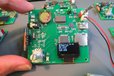
What is it? This radio is an enhanced version of my previous item. Now it has ATmega1284P with SRAM memory of 16kB and 128kB flash. More freedom for programming! In addition, now the board has USB-UA…
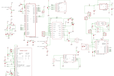
Read More…This radio is an enhanced version of my previous item. Now it has ATmega1284P with SRAM memory of 16kB and 128kB flash. More freedom for programming! In addition, now the board has USB-UART interface (CP2102N) and power source selecting jumper, which enables USB bus power operation. Moreover, the onboard RTC provides "current servicing station and frequency" information. Moreover, the channel step for MW can be configured by the rotary encoder.
The simple high-quality receiver is available on the market but they are mostly not programmable (no firmware access.) In addition, I've thought it will be very useful if "current servicing station info" is shown on display but as far as I know (and affordable one), it is not sold on the market.
Powerful ATmega1284P with 16kB SRAM and 128kB flash provides more programming freedom for you.
ATmega1284P program is supported by Arduino through MightyCore by MCUdude.
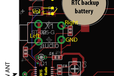
RTC (real time clock) by NXP PCF2129AT is able to show you the real-time information.
USB-UART by Silicon Labs. CP2102N is onboard. Just connecting USB cable (mini USB) is enough to program.
Power-source selection jumper for USB-bus power mode and Lipo charger/Lipo powered mode is added.
My firmware enables..
RTC setting by the rotary encoder, not hard-coded.
Time standard setting by the rotary encoder, not hard-coded.
MW channel step (9kHz or 10kHz) setting by the rotary encoder, not hard-coded anymore.
(RTC setting, time zone setting, and channel setting are required just one time for your initial power-on.)
According to the current date/time by RTC, current servicing broadcast station information is presented, which is stored in micro SD card. (Each hour, information will be renewed, and current firmware supports maximum 6 stations by each hour.)
What you will get by ordering this item?
Fully completed and tested radio board
microSD card (capacity is more than 512MB) with sample station data init.
What will be useful for your operation?
Lipo battery with 3.7V single cell with PH 2mm pitch connector. The new board can work on USB-bus power mode but for your portable operation Lipo operation may be more useful.
Good antenna: short-wave reception requires a good antenna. Connecting just a few meters wire will get some station but no external antenna will never receiver any station, especially for shortwave. Also, FM reception needs an antenna but really a few meters wire is enough to operate.
Additional information
The time and channel step should be just one time (or anytime) pushing SW next to rotary encoder. Once time and channel step are set, they are stored in RTC and EEPROM and we don't need to re-set every time. (of course, if we need to reset, then just pushing SW and new data can be stored.)
The current firmware will read simple text file from SD card. The SD card format is FAT16 and can be read by PC or Mac. The name of text file is, "STATION.TXT" and according to the current date/time by RTC, current servicing broadcast station information is presented. (Each hour, information will be renewed, and current firmware supports maximum 6 stations by each hour.) The "STATION.TXT" writing format is very simple, as is
---------format---------
CRI 11790
R.NZ 15720
.
.
.
.
CRI 15125
R.NZ 15720
.
.
.
.
-----format end----
If the line of "CRI 11790" is the top of the file, the text data of the first six lines will be presented at 0-UTC. If the current time is 1-UTC, then the next data, starting "CRI 15125" will be presented. Actually any text data (limited by 16 characters in each line) can be presented, according to RTC time.
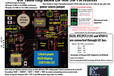
As for the antenna terminal, indeed I've forgot it to present it on the card. The connection is same as the original DSP radio, meaning top two terminals are SW and second two terminals are FM radio antenna terminal.
The audio volume is digitally controlled by the function of KT0915. If we need external volume control, then we need to add two tactile sw (which button can be accessed from external.) for it. As for power SW, just adding toggle SW parallel to the onboard one is enough.
Product: (5.00)
Documentation: (3.00)
Shipping: (5.00)
Communication: (5.00)
Robert | July 21, 2018
By clicking Register, you confirm that you accept our Terms & Conditions
We recognize our top users by making them a Tindarian. Tindarians have access to secret & unreleased features.
We look for the most active & best members of the Tindie community, and invite them to join. There isn't a selection process or form to fill out. The only way to become a Tindarian is by being a nice & active member of the Tindie community!