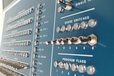
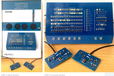
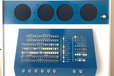
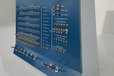
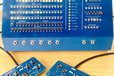
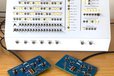
A faithful scale 6:10 replica of the PDP-1, fully compatible.
Designed by Obsolescence Guaranteed in Switzerland
Buy with confidence.
Our Tindie Guarantee protects your purchase from fraud. Learn More
What is it? The PiDP-1 is a modern replica of the PDP-1. Basic soldering skills are required to build the kit. Or you can choose the Assembled & Tested option. Please note you need to add your own Ra…
Read More…The PiDP-1 is a modern replica of the PDP-1. Basic soldering skills are required to build the kit. Or you can choose the Assembled & Tested option. Please note you need to add your own Raspberry Pi! It does not come with the kit. Any Pi from the Pi zero 2W up to the Pi 5 is fine.
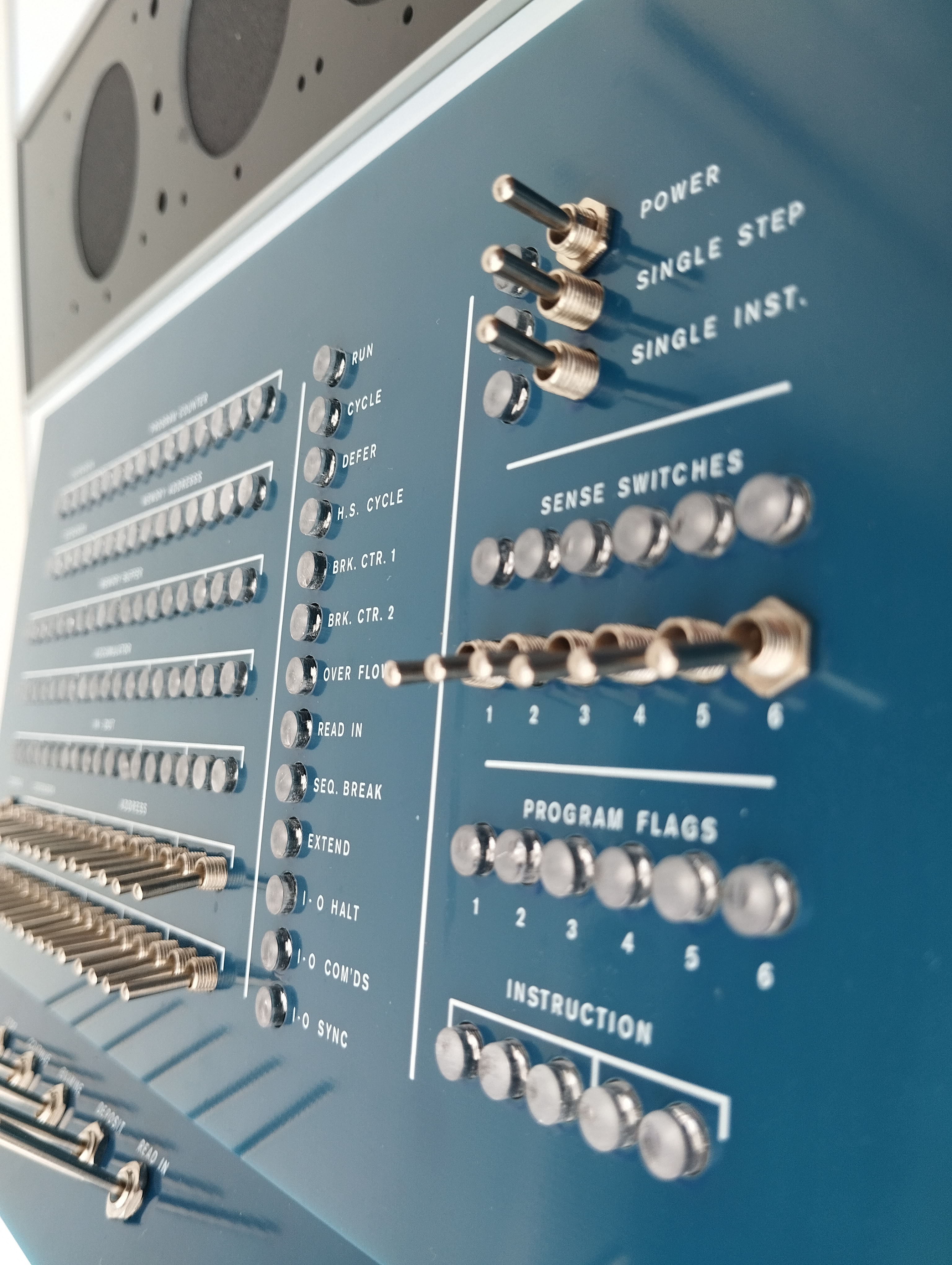
Introduced in 1959, the PDP-1 was the start of Digital Equipment Corporation and its PDP range of computers.
The PiDP-1 wants to bring back the hands-on experience of the PDP-1 front panel and its beautiful Blinkenlights. On a more modest (living room compatible) scale 6:10.
The PDP-1 history is told very well on Wikipedia. A team at the CHM restored one PDP-1 to working order; and Angelo Papenhoff has written exact simulators in Verilog and C - including the Type 30 display. Our replica is based on this simulator.
Three years ago, we started on the PiDP-1, to complete the PiDP series (-8, -10, -11). Little did we know that this adorable dinosaur would become our favourite of the whole range. The PDP-1 is a truly fun machine to work and play with - and so, this text turned out a bit less formal than the other machines' pages.
This is not just a retrocomputing kit! The PiDP-1 makes for a very cool-looking retro-gaming console. Very simple to use, plays the first video game ever (PDP-1 spacewar, even dual-screen). Add RetroPie to turn this into a universal retrogaming console playing any video game from before 1995... in a very retro-cool case :-)
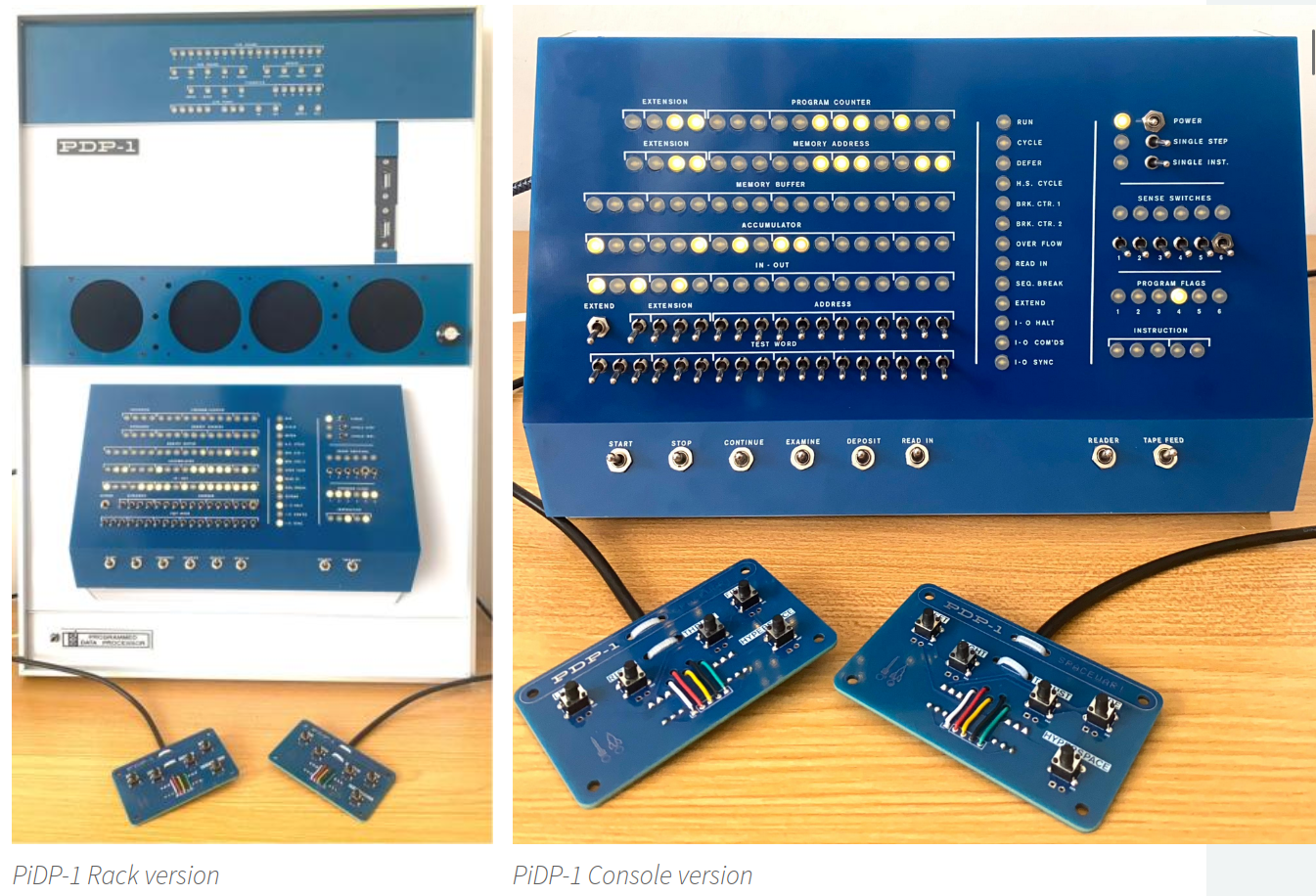
DEC made some PDP-1s as a table-top console panel, then mounted the panel on the rack itself.

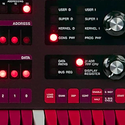
Another choice for DEC - and then for us - was whether to opt for a blue or white colour scheme. The replicas all come with interchangeable panels. You can swap between the white and blue at any time as we believe such a hard decision should be avoided.
There are two versions of the kit: the table-top Console and a Rack version of the PiDP-1. The two kit versions work the same, but the fancier Rack version can mount an optional 7" HDMI display inside, and uses USB sticks to replace the original paper tapes. The Rack version does include the Console-style case as well, so you can still travel with a PDP-1 :-)
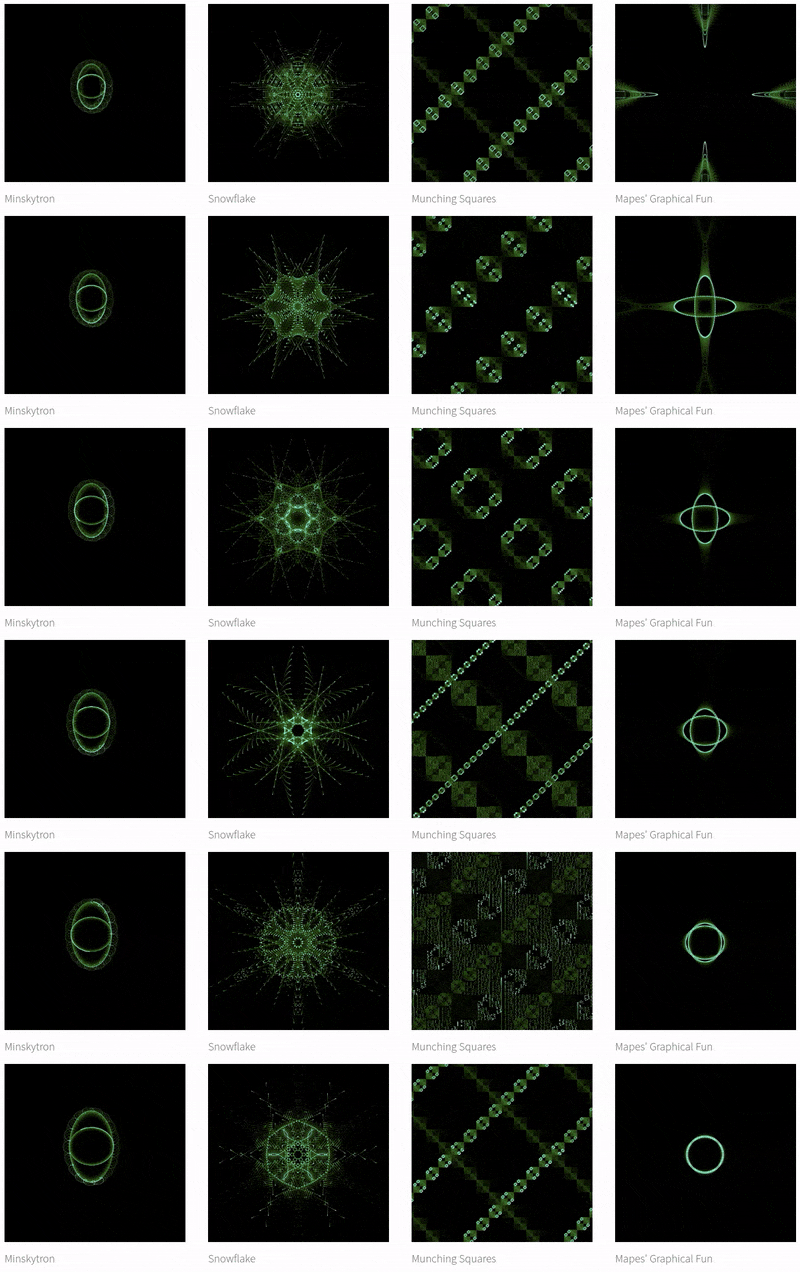
The PDP-1 was a first in many respects. But it is also simple enough to be quickly understandable to any 21st century computer user. It is the original Hacker's machine - the word comes from the hacker community forming around the PDP-1 at MIT; their demo programs are still attractive eye candy thanks to the Type 30 display, a converted radar display.
Driving the electron beam over its phosphor, you can get very pretty graphics effects from only a little bit of simple programming. Serious programs were also written: the first-ever text editors, a sensational Lisp, and FORTRAN. Even the first interactive multi-user system software. Much of this has been preserved and brought to run again.
Exactly because of its simplicity, this is the machine we'd really want to learn assembly language on. Before you laugh, let us give an overview of the machine from three different perspectives. Forgive us for such frivolity with a historical machine.
Is it a stretch to call a $100,000 computer from 1959 a games console? No. It is where the computer video game was invented: Spacewar! And it is where games controllers were first introduced. Games are still being written for the machine - hackers still exist :-)

The PDP-1 was tiny. Elegant, mean and lean graphics demos were thus a natural application for it. And that's not a trivial thing; a lot of graphics algorithms were invented here. And the notion of interactive graphics. Our goal with the PiDP-1 was to create some sort of a democoding scene for this dinosaur, and that is taking off in 2026, it looks like! Please join the fun.

Many ideas were born on the One: text editor, interactive debugger, the REPL concept from Python. And this was first-ever multi-user system. A PDP-1 also was Arpanet's real-time monitor, pushing the first-ever online software updates, to routers in the field. We're working on an Arpanet reconstruction, and the PiDP-1 will retake its role as the Network Control Center!

The PDP-1 used a simple 18-bit word architecture with a single accumulator, lacking all the complexity of modern CPUs. Its fast I/O and vector CRT display enabled real-time interaction, unlike the batch mainframes of the era.
The extreme simplicity made the computer easily 'hackable'. The diagram gives an overview of all there is in the system:
A CPU visible to the programmer as just an accumulator AC, an IO register (to send and receive 18 bits to the outside world), and of course a Program Counter PC. The fascinating thing is, to see that nothing more is actually needed to make a fully functional computer.
Three peripherals:
More devices could be added, but generally were not. Truly useful was a rotating drum storage, that had the ability to swap whole 4K pages in & out in the time of only a single instruction.
Amusingly, the PDP-1's most influential peripheral is not shown in the diagram: the Type 30 graphics display, which even at the time was considered the feature that gave the machine its character. Built from a converted radar tube, it took bits straight out of the IO register as X/Y coordinates. A simpler graphics subsystem could not be imagined. Still, the PDP-1 could plot 20K dots per second. The downside being, they had to be replotted a few times per second as there was no bitmap memory: the electron beam briefly lit up the phosphor, and even with a slow-phosphor radar tube the dot would fade quickly if not redrawn quickly.
The PiDP-1 is also a pretty fun games console, running various versions of Spacewar, including a recently recovered dual display spacewar, as well as games from the 21st century demoscene, notably Pong and Lunar Lander. Given that there is a Raspberry Pi inside: install RetroPie and you have a very cool looking games console able to play you any game from 1960 to 1995!
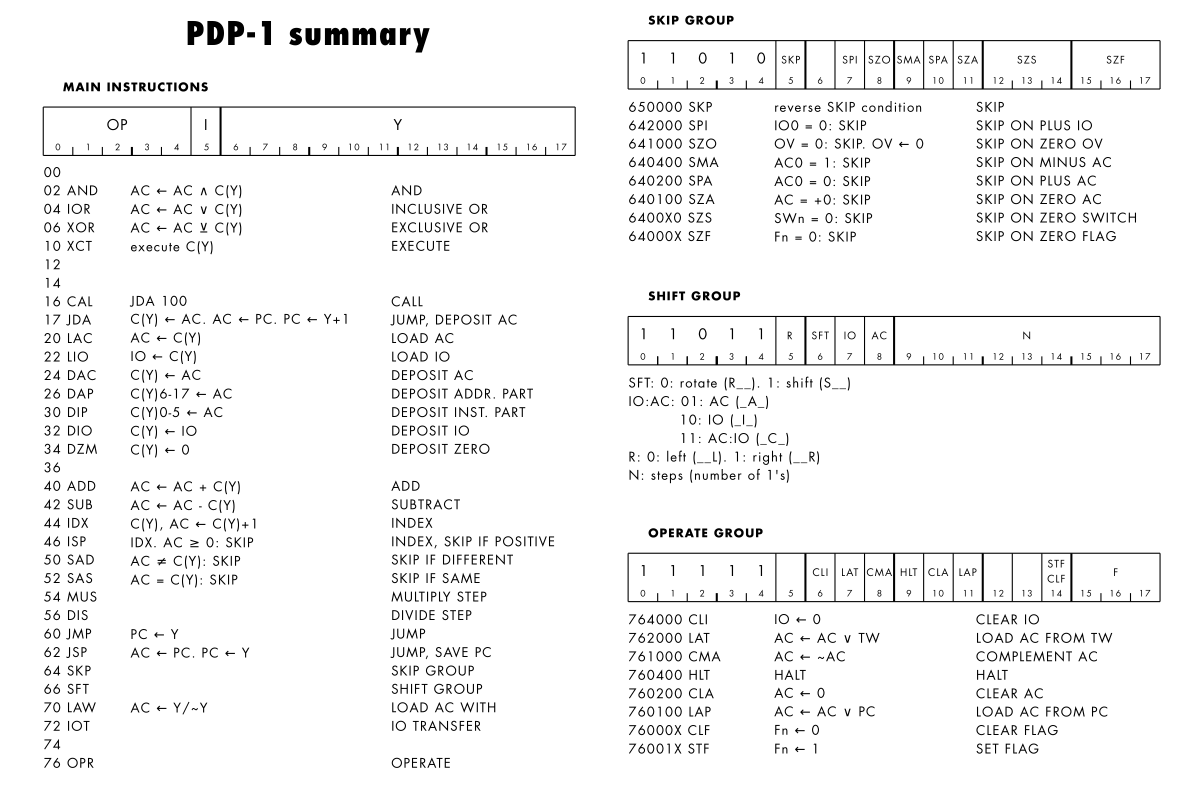
The instruction set was equally minimalistic - but very clever in eking out the maximum of features from what was possible with just 2700 transistors (even a 6502 had 3500 - an 8086 took 26000). In the 18-bit accumulator, 5 bits encoded the instruction number, 1 bit was used to indicate indirect addressing, and the remaining 12 bits could hold a memory address to be used by the instruction.
Of course, if an instruction has to be encoded in 5 bits, you can't have more than 32 different instructions. In fact, the PDP-1 kept it to 27. But some instructions that did not need to encode a memory address were like Swiss Army knives - their 12 free bits could trigger flip-flops in the machine to drive many special actions. Clear the AC, clear the IO, each of these things only needs one bit - and can thus be packed together in one Swiss Army knive instruction.
Still, 27 instructions can be condensed on a small cheat sheet and are easily remembered with just that at hand. It made assembly-language programming very, very easy to start with. But the price for that of course was that you needed to be truly ingenious to craft a more complex program within those confines. Even then - with only 27 instructions to know, the 'poetry' of PDP-1 code is very easy to read for anyone with basic computer knowledge today. That is part of the joy of studying the PDP-1: its programs are easy-to-understand logic poems'. We did apologise for the informal tone of this page, right?
Of course, we hope we have whetted your appetite for a PDP-1 test drive. You can install and run a virtual PDP-1 on your Linux laptop or a Raspberry Pi from our github (link). No further hardware required, although if you want you can use our hardware replica with the exact same software.
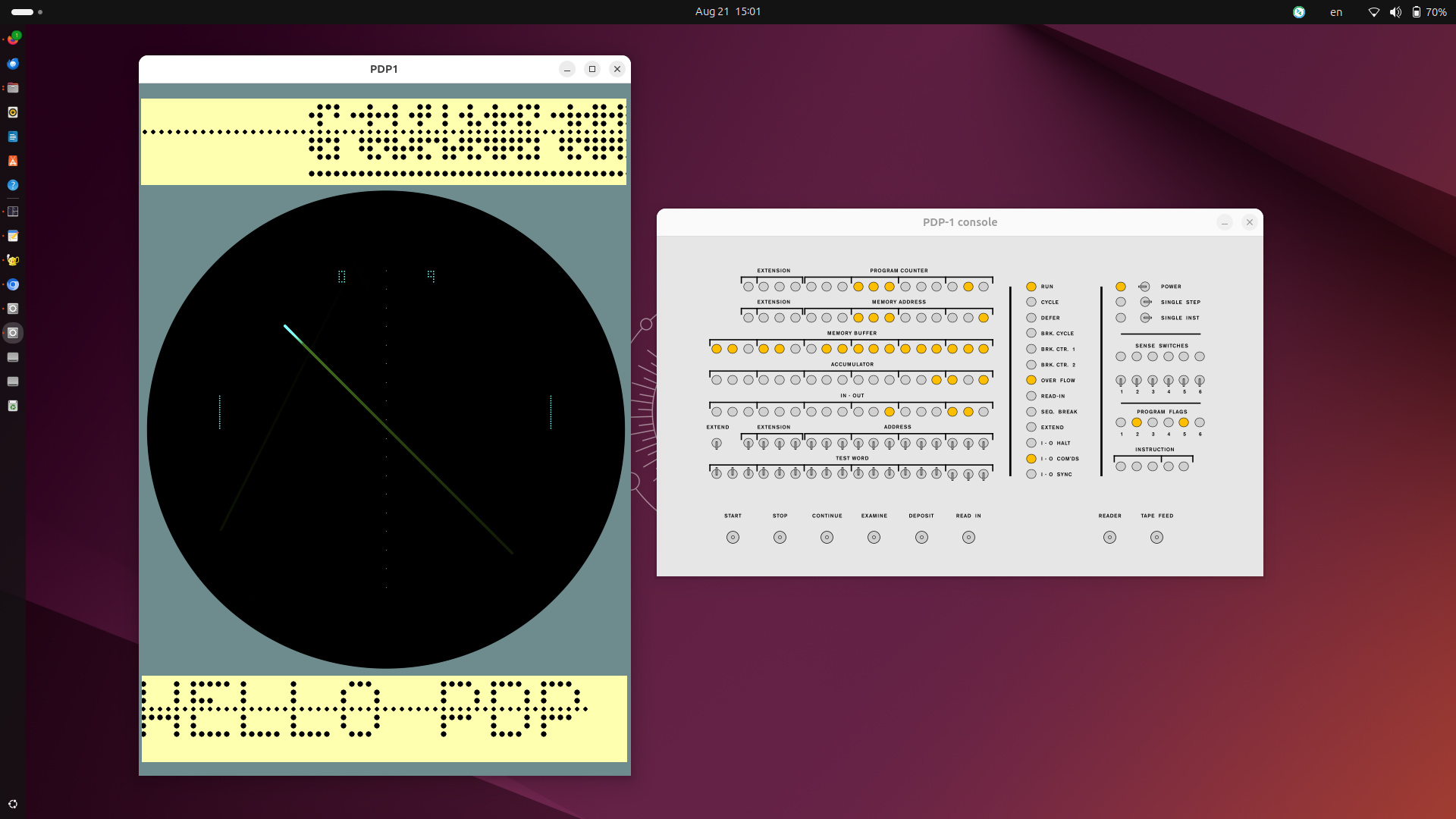
Please visit the PiDP-1 project web site for the manual and much more information. There is also a lively PiDP-1 Google Group.
If you choose the larger PiDP-1 Rack version, assembled: you will still need a screwdriver to put the panels in the rack, and connect some cables. Shipping the Rack fully assembled would incur risk of shipping damage.
Please visit Our Building Instructions page, and the online manual
Buy with confidence.
Our Tindie Guarantee protects your purchase from fraud. Learn More

/i/370451/products/2026-01-04T15%3A58%3A25.030Z-c2.jpg?1767515331)